This article explores why European developers, architects, and importers increasingly rely on Chinese Green Marble for airports, shopping malls, and hotel lobbies — combining aesthetic depth with technical reliability.
A Dialogue Between Design and Supply
Architect (Paris): “Our client wants a statement lobby — something organic yet refined. Is Chinese Green Marble consistent enough for such a scale?”
Exporter (Xiamen): “Absolutely. Every block is digitally mapped and resin-treated for uniform tone. From quarry to crate, consistency is our signature.”
This cross-continental conversation represents today’s design reality — collaboration between European creativity and Chinese precision. Together, they shape a greener, more timeless architectural future.
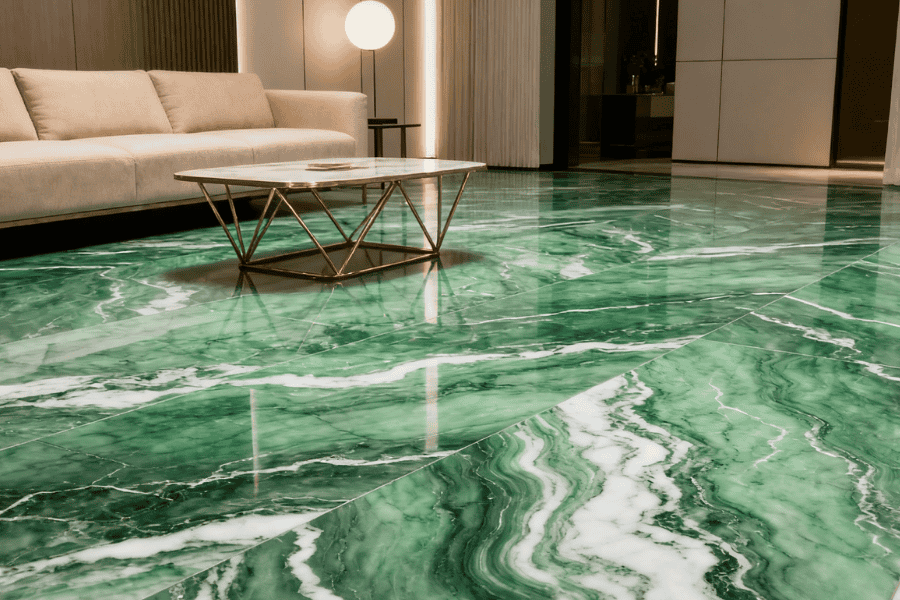
What Makes Chinese Green Marble Unique
Unlike traditional white or beige stones, Green Marble carries an emotional depth — its mineral veins mimic nature’s patterns, blending serenity with strength.
Sourced primarily from provinces like Yunnan, Guizhou, and Fujian, these marbles range from Verde Oriental to Emerald Jade, each offering unique chromatic layers.
Key Advantages
Color Diversity: From forest green to mint tones, matching both modern and classic design palettes.
High Density: Suitable for flooring in heavy-traffic commercial projects.
Water Resistance: Excellent for European climates with high humidity.
Easy Finishing: Can be polished, honed, or leathered with minimal surface distortion.
Material Strength and Performance
Beyond beauty, Chinese Green Marble performs exceptionally well under European building standards.
| Property | Average Value | European Standard |
|---|---|---|
| Compressive Strength | 130–150 MPa | EN 1926 compliant |
| Water Absorption | ≤0.3% | Excellent for humid regions |
| Flexural Strength | 14–18 MPa | Suitable for large slabs |
| Density | 2.7 g/cm³ | High structural integrity |
These characteristics make it ideal for large-scale installations — airports, retail centers, and museums — where both visual continuity and mechanical strength are critical.
From Quarry to European Project — The Journey
Every slab of Green Marble starts its journey in China’s meticulously managed quarries.
-
Extraction: Eco-conscious mining minimizes dust and waste.
-
Block Cutting: 5-axis CNC saws ensure uniform thickness.
-
Resin Reinforcement: Strengthens internal veins for shipping durability.
-
Quality Control: Each piece inspected under EN 1469 standards.
-
Export Packaging: ISPM-15 wooden crates, foam-lined for moisture resistance.
Once loaded, containers travel from Xiamen or Yunfu ports to Rotterdam, Antwerp, or Hamburg, reaching European distributors within 30–45 days.
Why European Designers Choose It
Europe’s design philosophy now revolves around natural storytelling.
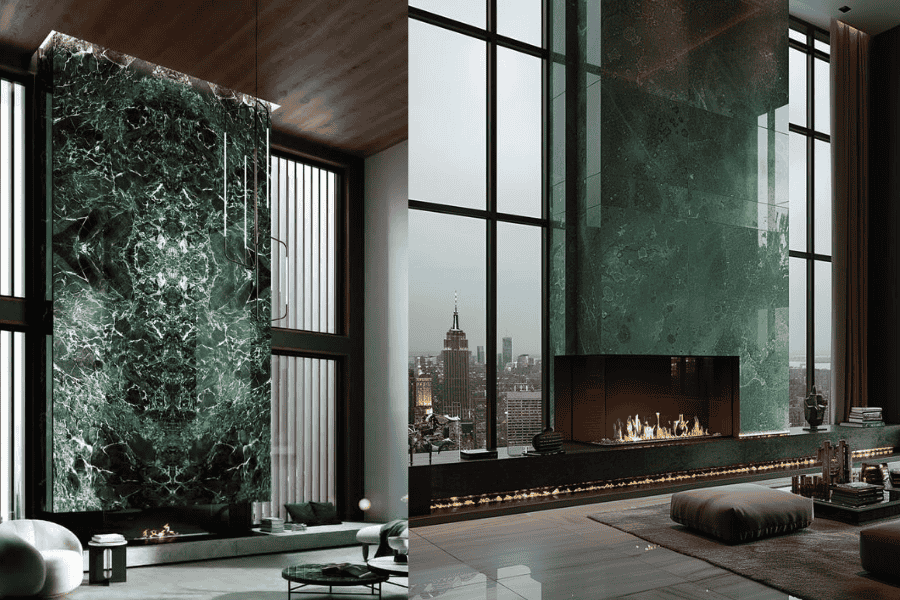
Green Marble plays a vital role in biophilic design — reconnecting people to nature through color and pattern.
Design Drivers
Sustainability: 70% of EU-based architects now prefer natural materials over synthetics.
Visual Calm: Green tones promote balance in commercial and hospitality interiors.
Cultural Symbolism: Associated with longevity, renewal, and sophistication.
Versatility: Perfect for cladding, flooring, and artistic installations.
OEM Workflow and Export Assurance
The best green marble suppliers from China combine traditional craftsmanship with digital precision.
Each batch includes full traceability — from quarry source to slab ID. Exporters provide:
3D block mapping for pre-approval.
AQL-level inspection for color consistency.
Batch numbering system for every shipment.
Moisture testing and surface calibration reports.
Their factories now operate under ISO 9001, EN 1341, and ASTM C503 certifications, ensuring European buyers can confidently specify Chinese marble in public tenders and private contracts alike.
Sustainability and Global Impact
Chinese suppliers have shifted toward green quarrying technologies and solar-powered fabrication plants, aligning with EU environmental expectations.
Water recycling systems in cutting facilities now recover up to 90% of process water, and resin substitutes are increasingly VOC-free.
For architects pursuing LEED or BREEAM certifications, this makes Chinese Green Marble not just beautiful — but responsible.
Before importing or specifying Green Marble for European or Middle Eastern projects, consider these essential factors to ensure consistent color, performance, and long-term satisfaction.1. Color and VeiningDark Greens (e.g., Verde Alpi, Verde Indio): Strong contrast and bold veining — ideal for statement walls and luxury interiors.
Light to Medium Greens (e.g., Verde Issorie, Ming Green): Subtle patterns that suit minimalist or contemporary spaces.
2. Surface Finish
Polished: Enhances depth and reflection; perfect for feature walls and flooring.
Honed / Leathered: Provides a matte, slip-resistant texture, preferred in public or humid areas.
3. Recommended Applications
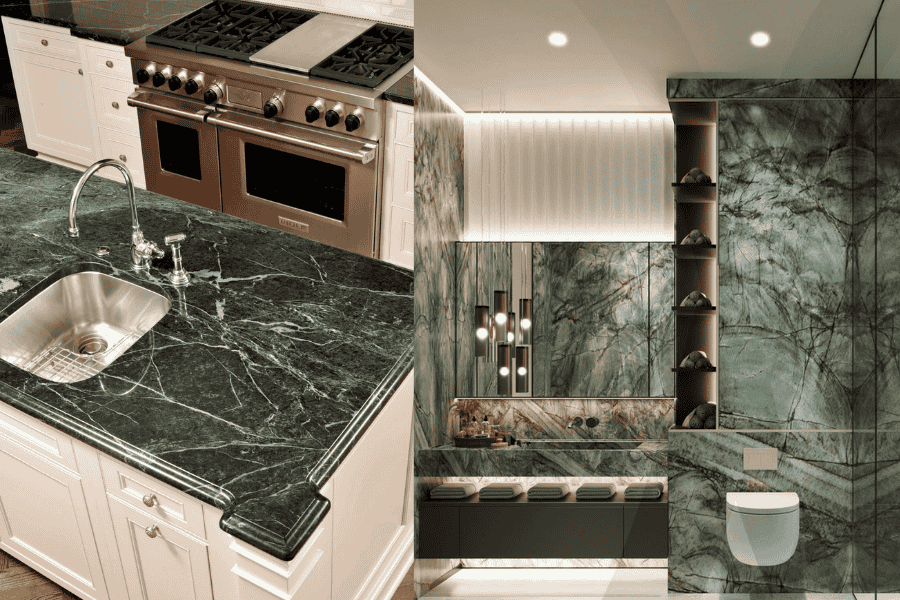
Countertops, hotel lobbies, wall panels, stairs, and public atriums.
Works beautifully when combined with brass, wood, or light terrazzo tones.
4. Maintenance Tips
Seal surfaces every 6–12 months depending on humidity exposure.
Use neutral pH cleaners to maintain shine and prevent etching.
Always verify finish compatibility with project lighting and usage.
Pro Tip:
When importing from China, request block-matching photos before shipping.
This ensures uniform veining across large installations — a standard practice among the best green marble suppliers from China.
Expert Insights
“Green marble is not just a decorative stone — it’s a narrative of geology and craftsmanship,” says Dr. Lina Moretti, a materials scientist at Milan’s Politecnico University.
“Chinese Green Marble performs remarkably well in density and flexural strength, which allows architects to design large, continuous installations without visible joints.”
Designers across Italy, Germany, and the UAE confirm that Green Marble’s low porosity and excellent polish retention make it a reliable option for both commercial and residential interiors.
Scientific Data & Performance Metrics
| Property | Average Range | Tested Standard | Notes |
|---|---|---|---|
| Density | 2.68 – 2.75 g/cm³ | EN 1936 | High structural integrity for façades and floors |
| Water Absorption | ≤0.3% | EN 13755 | Excellent resistance to moisture |
| Flexural Strength | 14 – 17 MPa | EN 12372 | Ideal for large panel installations |
| Mohs Hardness | 3.5 – 4 | ASTM C241 | Moderate hardness with high polish potential |
These results show that Green Marble meets and often exceeds European building standards, offering dependable performance in humid, coastal, and high-traffic environments.
Application Scenarios and User Feedback
Real project feedback reflects how Green Marble enhances both modern and classical architecture:
-
🏛 Doha Exhibition Center: Green Marble cladding used to reflect cultural heritage with modern structure symmetry.
-
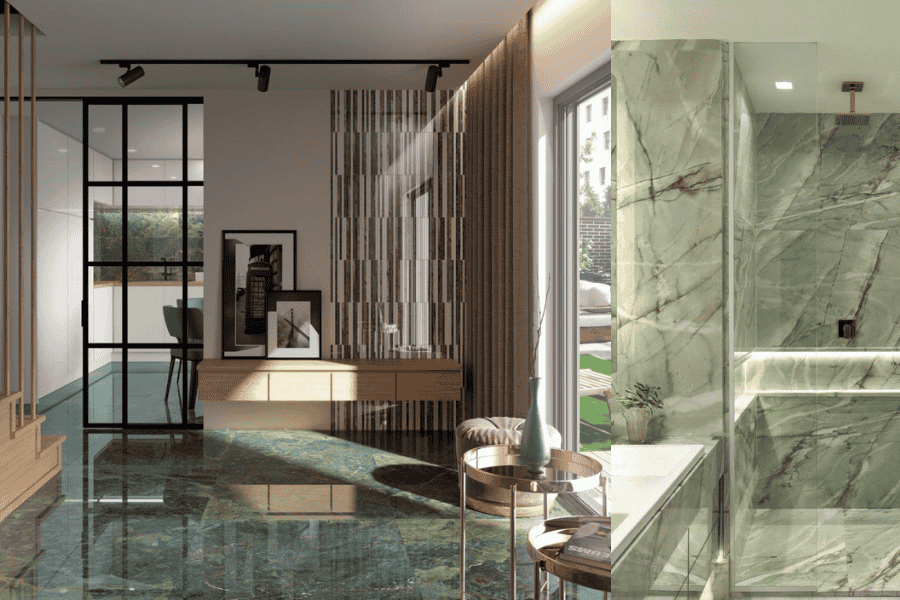
🏨 Munich Luxury Hotel: Bathroom and lobby applications praised for visual warmth and reflection depth.
-
🏢 Dubai Office Tower: Honed finish used on vertical surfaces to minimize glare under artificial light.
“We chose Chinese Green Marble for its visual depth and supply reliability — every shipment arrived calibrated and book-matched,”
— Architectural Supervisor, Riyadh.
Maintenance & Longevity Tips
To preserve Green Marble’s elegance and performance for decades:
-
Seal the surface every 9–12 months with a penetrating, breathable sealer.
-
Avoid acidic or bleach-based cleaners — they cause micro-etching over time.
-
Use soft microfiber mops instead of abrasive pads.
-
Maintain humidity balance in indoor areas to prevent subtle shade shifts.
-
Inspect grouting annually, especially in bathrooms or poolside installations.
🧼 Pro Insight:
For high-traffic flooring, opt for honed or leathered finishes instead of polished. They maintain visual balance and reduce visible wear patterns.
FAQ
1. Why do European buyers prefer Chinese Green Marble?
It offers consistent color, high density, and excellent pricing compared to Italian or Indian alternatives — without sacrificing quality.
2. What finishes are most popular in Europe?
Honed and satin finishes dominate the European market for their soft light diffusion and anti-slip properties.
3. How long does shipping from China to Europe take?
Typically 30–45 days via sea freight, depending on port congestion and destination.
4. How can buyers ensure color consistency across large orders?
Use block-based production and request real-time photos during cutting and packaging stages.
5. Are Chinese Green Marbles suitable for exterior use?
Yes. With proper sealing, they maintain their polish and structural strength under variable European climates.
References
-
Stone World Magazine – “Green Marble Trends in European Design”
-
European Construction Journal 2025
-
CNMIA – “Export Statistics of Chinese Marble”
-
Global Trade Logistics Review
-
ArchDaily – “Nature-Inspired Architecture in Europe”
-
EN Standards Documentation: EN 1469, EN 1926
-
World Architecture News – “Sustainability in Stone Sourcing”
-
LEED Materials Guide 2025
-
Quarry Sustainability Report – Fujian Province 2024
-
Design Boom – “Modern Hotels Using Green Marble Elements”
“Chinese Green Marble succeeds in Europe because suppliers understand both aesthetics and compliance. They know that consistency, sustainability, and logistics transparency matter as much as beauty.”From Italian boutique hotels to German subway stations, Green Marble is redefining modern interiors with subtle drama and organic charm.
European importers value not only the material’s visual richness but also China’s ability to adapt — blending technology with tradition.
With traceable quarries, automated surface finishing, and meticulous inspection, these suppliers are setting new standards in natural stone export.
The result is a stone that tells a global story — born in Asia, admired in Europe, and built to last for generations.