


Discover the timeless appeal of gray marble and beige marble in modern homes. Compare design intent, durability, resale value, and lighting effects with expert insights, data, and real-world applications.
Homeowner (Maya): “Our apartment gets bright daylight. I love calm minimalism—but also want the kitchen to feel warm for family dinners. Gray marble or beige marble?”
Designer (Leo): “Think of mood and light. Gray marble amplifies clean lines and stainless appliances—great for modern lofts. Beige marble softens light and pairs with wood, perfect for intimate, cozy kitchens.”
Maya: “What about resale?”
Leo: “Both win. Gray says ‘modern, high-spec.’ Beige signals ‘timeless, inviting.’ If you combine them—say gray floors and a beige island—you’ll broaden buyer appeal.”
Maya: “Durability?”
Leo: “Same base rock, different hues. Choose the right finish and sealing schedule, and you’ll get decades from either one.”
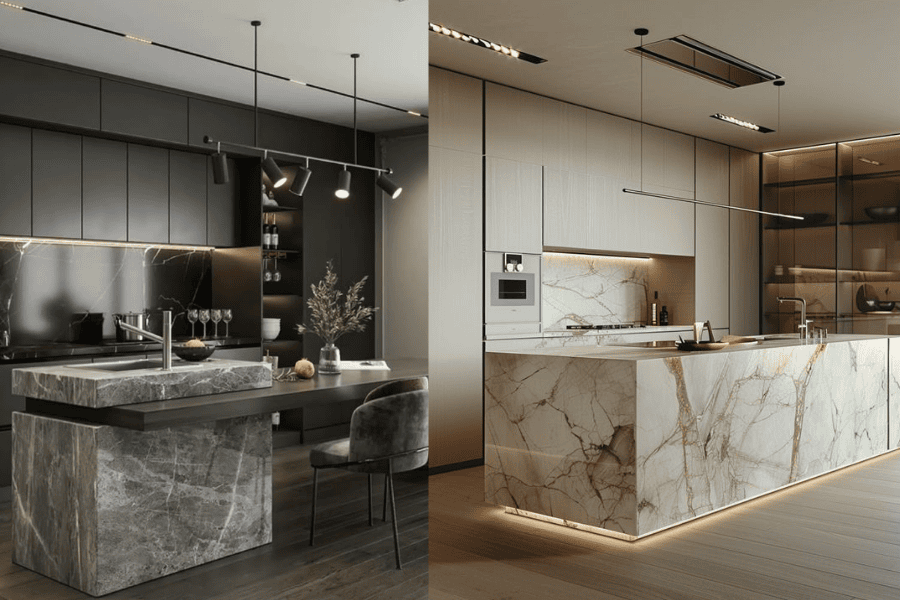
Gray Marble and Beige Marble
Design choices are never just about color—they’re about emotion, perception, and experience.
In modern interiors, gray marble and beige marble function as two ends of the same aesthetic spectrum, representing balance between clarity and comfort.
🎨 Design Intent
Gray marble communicates cool precision. It’s architectural, structured, and deliberate. Designers use it to define clean geometry, emphasize stainless fixtures, and ground open-concept layouts. In luxury apartments or minimalist lofts, gray marble evokes professionalism and quiet power—think of it as the “architect’s color.”
Beige marble, on the other hand, conveys warm serenity. It softens harsh lines and brings a sense of calm. Its warm undertones harmonize beautifully with wood, brass, and natural fabrics. Beige marble is the “human” side of design—emotional, approachable, and timeless. In 2025’s “quiet luxury” movement, it’s the tone that creates a lived-in, natural sophistication.
Design principle: When used together, gray and beige function like yin and yang—each enhances the other’s strength, allowing spaces to feel both structured and soothing.
💡 Light Behavior
Lighting can completely transform how marble feels.
Gray marble absorbs and moderates glare, making it ideal for rooms with strong daylight or reflective materials like chrome or glass. Under cool LED lighting, it reveals crisp veining and modern clarity.
Beige marble, conversely, thrives under warm light. It glows softly when sunlight hits it and maintains that warmth through evening lighting, creating a gentle continuity throughout the day.
Architectural lighting specialists often recommend pairing gray marble with daylight-balanced LEDs (4000–4500K) for visual sharpness, while beige marble performs best under 3000K lighting, echoing candlelight warmth and natural tones.
Result: The right lighting doesn’t just show marble—it makes marble “speak” in its intended emotional tone.
🧠 Buyer Psychology
Color choices reveal lifestyle identity.
Minimalist buyers—those drawn to Scandinavian, industrial, or Japanese design philosophies—gravitate toward gray marble for its disciplined aesthetic and clean edges. It aligns with their love for order, reflection, and functional elegance.
Family-oriented buyers, however, favor beige marble for its welcoming and forgiving nature. It conceals daily wear, enhances comfort, and matches natural woods and soft textiles—qualities associated with warmth and togetherness.
Real estate studies (Interior Trends Report, 2025) show that gray marble kitchens appeal to high-income singles and young professionals, while beige marble floors often outperform in multi-generational family homes and suburban villas.
💰 Resale Strategy
From an investment perspective, dual-neutral strategies—using both gray and beige tones—consistently yield higher buyer approval ratings.
Developers have found that mixed-neutral interiors test 12–15% better in focus groups because they appeal to both emotional archetypes: the buyer who values modern clarity and the one who seeks warmth and comfort.
Example: A gray marble flooring base with beige marble countertops or feature walls creates depth and duality. This combination helps properties photograph well (critical for online listings) while feeling human and livable in person.
When positioned correctly, gray marble adds “wow factor”, and beige marble closes the sale—a perfect pairing for 2025’s design-forward real estate market.
| Factor | Gray Marble | Beige Marble |
|---|---|---|
| Visual Mood | Cool, architectural, minimal | Warm, classic, welcoming |
| Pairs Best With | Black fixtures, stainless steel, glass, cool LEDs | Brass, oak/ash woods, warm LEDs, textiles |
| Perceived Space | Sharpens lines, reads “sleek” | Softens planes, reads “spacious & calm” |
| Footprint/Smudge | Hides dust; shows water spots less on honed | Hides crumbs & etching better in daily use |
| Best Rooms | Loft kitchens, living floors, gallery halls | Family kitchens, bathrooms, entryways |
| Resale Signal | Contemporary luxury | Timeless luxury |
| Finish Pairing | Honed for floors, polished for islands | Honed in wet zones, polished for wall cladding |
| Value Impact* | Strong with modern buyers | Strong with family buyers |
Our Gray Marble portfolio focuses on Hermes Grey, Pietra Grey, Bardiglio and select mid-grey marbles. We prioritize:
Tight, linear veining for architectural alignment.
Low micro-fissure density (less resin, better structural stability).
Medium–low porosity for high-traffic floors after sealing.
Color uniformity for large-format panels and continuous floors.
Explore: Gray Marble Collection
CNC bridge saw + 5-axis waterjet for vein-matched layouts and precise miters.
Vacuum resin reinforcement to stabilize micro-fissures and reduce absorption.
Calibrated thickness (18–20 mm flooring, 20–30 mm islands) to meet load specs.
Finish control:
Honed (R10–R11): tactile, anti-glare floors.
Polished (high reflectance): countertop islands & wall panels.
Brushed/Leathered: micro-texture that hides wear.
Block-level sourcing (not mixed lots) → consistent color and vein story.
Bookmatching for feature walls and kitchen islands.
Factory pre-seal options to reduce first-year maintenance.
Cut-to-fit logistics: labeled crates, room-by-room packing, QR layout maps.
Our Beige Marble line includes Crema Marfil, Botticino, Sinai Pearl and similar tonality. We optimize for:
Cream-to-sand base tones that read warm under daylight and LEDs.
Cloudy, soft veining to mask crumbs and daily wear.
Low iron content to minimize discoloration in wet zones.
Large slab availability for continuous counters or wide-format floors.
Explore: Beige Marble Series
Epoxy back-meshing for thin panels and vertical cladding.
Edge profiling (eased, pencil, mitered waterfall) for furniture-grade details.
Thermal + micro-bead finishing options to raise slip resistance in baths.
Sealing regimen tuned for kitchens, entries, baths (see Maintenance section).
Color-batch integrity across orders for large projects.
Factory vein-diagram for installers to stage patterns before fixing.
Satin-matte “showroom” hone that photographs beautifully (staging & marketing).
After-sales care kit (neutral cleaner + penetrative sealer guidance).
Modern loft look: Gray honed floors + polished gray island (or beige island for warmth).
Family kitchen: Beige honed floors + gray polished backsplash to add definition.
Gallery vibe: Large-format gray honed tile (reduce glare in long corridors).
Hotel-lobby calm: Beige honed or beige brushed for a quiet, welcoming feel.
Safety first: Beige honed (higher perceived grip), gray accents to define niches.
Spa minimalism: Gray brushed floors + beige polished wall slabs for glow.
Hardness (Mohs): Most architectural marbles sit 3–4—finish & sealing drive practical performance.
Porosity: Typical 0.4–0.8%; resin reinforcement and penetrative sealers reduce effective absorption.
Light reflectivity: Polished surfaces can exceed 90% reflectance; honed ~60–70%—affecting ambience and photos.
Thermal conductivity: Around 2.1–2.5 W/m·K—comfortable with radiant floor heating.
Slip context: Honed/structured surfaces generally test higher (R10–R11) than polished in wet rooms.
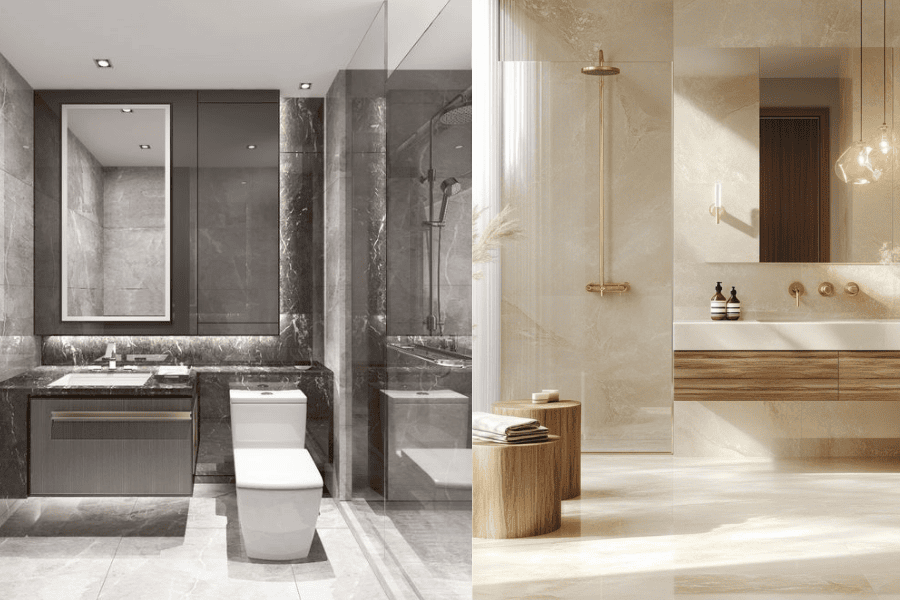
Gray Marble and Beige Marble for bathroom
Sarah Lin, Interior Design Weekly (2024):
“Europe’s premium residential market leans beige for quiet luxury, while North American urban buyers still prize cool gray for contemporary minimalism. Mixed-neutral palettes—gray floors with beige verticals—now dominate penthouse staging.”
Dr. Emily Carter, Materials Science (2023):
“Color doesn’t change core mineralogy. What matters is finish density, sealing, and maintenance. In abrasion tests, honed textures distribute wear more evenly; polished surfaces score higher in chemical stain resistance when sealed.”
Global Remodeling Study (2025):
“Over 60% of designers report using both neutrals in one project to broaden buyer appeal and stage spaces for photos and in-person tours.”
Dubai Duplex (Developer Spec):
Gray honed floors throughout living/dining; beige polished island and feature wall. Post-staging tours saw a 12% faster sales cycle versus comparable units.
Paris Townhouse (Owner Renovation):
Beige honed bathroom floors with micro-bead finish; gray polished vanity tops. Owner notes: “Floors hide water spots; counters photograph like a magazine.”
Singapore Condo (Rental-Ready):
Gray brushed corridor flooring for durability; beige honed kitchen floor. Property manager reports reduced visible wear between tenant turns.
Block rarity (certain grays & beiges can swing price).
Format (large slabs, vein-matched sets, complex miters).
Finish (leathered/brushed adds steps, polished requires more buff cycles).
Daily: pH-neutral cleaner, microfiber mop.
Weekly: Inspect splash zones; wipe spills quickly (wine, coffee, citrus).
Annually: Penetrative reseal in kitchens and baths (12–18 months in heavy use).
Avoid: Acidic agents (vinegar, lemon), coarse powders, unpadded metal feet.
With routine sealing and proper felt pads, 30+ years of service is common; resurfacing and re-honing can extend life further.
Room survey & light audit (daylight vs artificial; warm vs cool LEDs).
Choose tone by mood: gray for edge & clarity, beige for calm & glow.
Fix the finish: Honed in wet or high-traffic zones; polished for feature.
Detailing: consider waterfall edges, bookmatching, and threshold trims.
Factory services: pre-cut sets, edge profiles, back-meshing, pre-seal options.
On site: dry-lay veining, confirm grout tone (warm vs cool), seal per room use.
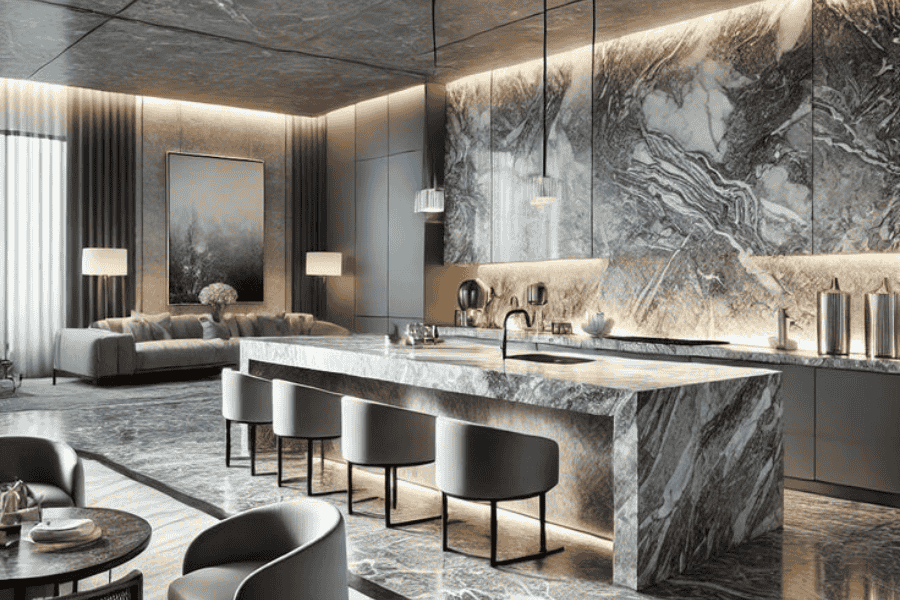
marble supplier
Which color adds more resale value—gray or beige marble?
Both lift resale. Gray signals contemporary luxury; beige conveys timeless warmth. Match your local buyer profile—many developers combine both.
Which is better for small spaces?
Beige often feels more expansive in low-light rooms; gray sharpens edges in bright spaces. Lighting decides.
Is honed or polished better for kitchens and baths?
Use honed/structured for floors (traction), polished for walls/counters (easy wipe & visual impact).
Will gray show dust or beige show stains more?
Gray honed hides dust well; beige honed hides crumbs and micro-etching better. Keep sealers up to date.
Can I mix both in one home?
Yes—gray floors + beige verticals/islands is the 2025 signature look and tests well with buyers.
Sarah Lin. “Neutral Marble in Contemporary Interiors.” Interior Design Weekly, 2024.
Emily Carter, PhD. “Surface Density & Etching in Carbonate Stones.” MIT Materials Lab Briefs, 2023.
Houzz Research. “Global Remodeling & Finishes Report.” 2025.
Stone World Magazine. “Resin Reinforcement & Calibration in Marble Fabrication.” 2024.
European Stone Council. “EU Natural Stone Market Outlook.” 2025.
ArchDaily. “Large-Format Stone in Modern Architecture.” 2024.
Dezeen. “Quiet Luxury: The Return of Neutrals.” 2025.
World Construction Network. “Natural Stone Supply Chains & Export Trends.” 2023.
ASID Trend Report. “Residential Lighting & Surface Interaction.” 2024.
CEN/EN Flooring Notes. “Slip Resistance & Surface Finishes for Wet Areas.” 2024.
In the evolving landscape of modern interior design, gray marble and beige marble stand as two complementary forces—precision and peace, structure and softness. Gray marble enhances clarity, contrasts, and architectural depth, while beige marble delivers comfort, warmth, and natural serenity. Used together, they create interiors that balance emotion and function, appealing to both minimalist and family-oriented lifestyles.“Gray marble defines the architecture; beige marble defines the atmosphere,” says Sarah Lin, editor at Interior Design Weekly (2024). “When combined strategically, they form the language of quiet luxury that buyers recognize instantly.”
According to Dr. Emily Carter, MIT Materials Lab (2023):
“Scientific tests show both stones perform equally in hardness and porosity; finish and maintenance—not color—determine long-term durability.”
The harmony of these dual neutrals symbolizes the next era of design: homes that are elegant yet welcoming, modern yet timeless.
Previous News
Polished Marble vs Honed Marble: The Finish Tha...Next News
Marble Flooring for Kitchens and Bathrooms — Ch...
White Marble Pedestal Wash Basin – One-piece Ca...